Introduction
The cybersecurity ecosystem has just changed the rules of the game. As of today, March 15, 2026The new regulation reducing the validity of SSL/TLS certificates to a maximum of 200 days.
If your website uses manually issued certificates or certificates valid for one year, Safari and Chrome will start marking them as "Not safe.". It's not your server's error, it's the new browser trust policy.
Table of Contents
Why the change to 200 days?
This measure, initially pushed by Apple and adopted by the CA/Browser Forum, seeks to force the cryptographic agility.
🔶 Key Rotation: It reduces the time a compromised key can be useful to an attacker.
🔶 Algorithmic Update: Facilitates rapid transition to quantum computing resistant ciphers.
🔶 Continuous Validation: It forces domain owners to prove their identity twice as often.
The Reduction Schedule
This is only the first step in an aggressive roadmap towards short-duration certificates:
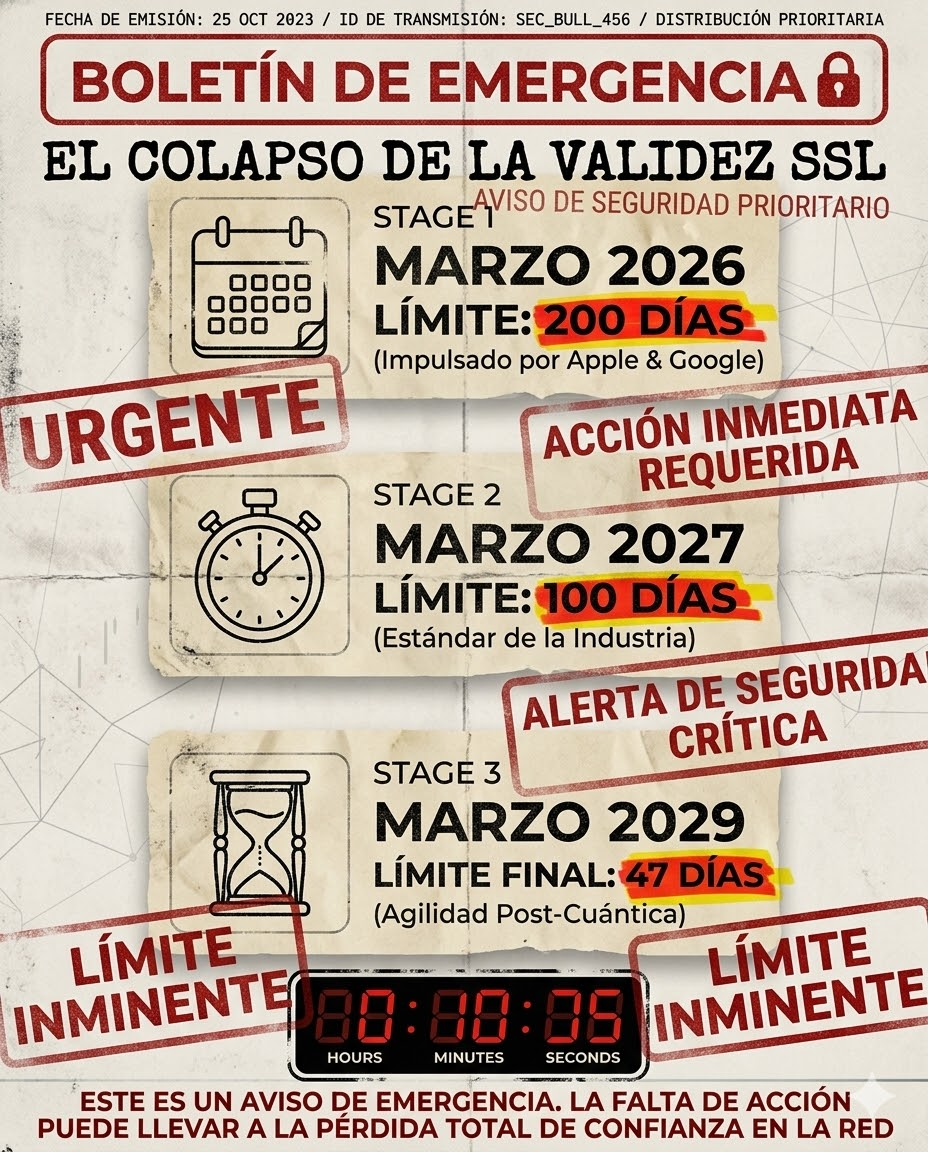
- March 2026: 200-day limit.
- March 2027: Reduction to 100 days.
- March 2029: The final standard of 47 days.

How to avoid "Connection not private" error
The era of installing files .crt and .key by hand is over. Manual management is now an operational risk.
The Solution: ACME Protocol
To survive semi-annual (and soon quarterly) renewals, you must implement full automation.
- Use Auto-SSL: Make sure your control panel (cPanel or Plesk) has automatic renewal enabled.
- Configure Certbot: If you manage VPS or dedicated servers, automate with scheduled tasks.
- Expiration Monitoring: Implement alerts that notify you 30 days before new short cycles.
Infrastructure Tip: Renovation Verification
If you use Nginx or Apache, you can verify that your automatic renewal system is ready for the new 200-day cycle with this command:
					Bash
# Verify the current expiration date from the terminal
openssl x509 -enddate -noout -in /path/to/your/certificate.crt

# Force a renewal test with Certbot to ensure compatibility
sudo certbot renew --dry-run
💡 Tip: If the "dry-run" fails, your server will not be able to comply with Apple's regulations and the site will go down in the next cycle.
Conclusion: Don't let your SSL lapse
At ClickPandaWe've upgraded our entire hosting infrastructure to support short lifecycles natively. Our servers handle the automatic renewal for you, ensuring that Safari and Chrome always see your site as secure.
Is your current supplier still selling 1-year certificates? It's time to migrate to a future-proof platform.